Sub-Total: $0.00
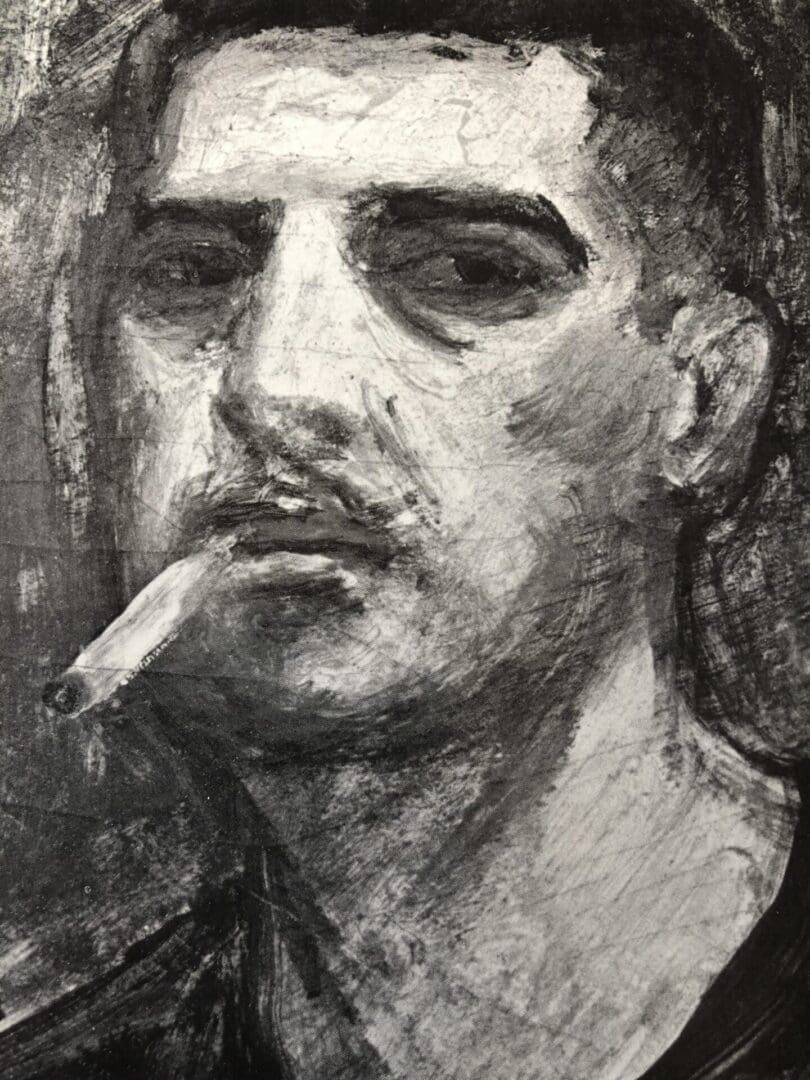
Kotin’s “Self Portrait”
Description
Albert Kotin (1907–1980)
Abstract Expressionist and Postwar Innovator
Early Life & Education
Albert Kotin was born in Minsk, Russia (now Belarus), in 1907 and immigrated to the United States with his family as a child. He grew up in New York City, where he would later become a pivotal figure in the American Abstract Expressionist movement. Kotin studied at the National Academy of Design and the Art Students League of New York. He furthered his education in Paris at the Académie Julian and other schools during the 1930s, immersing himself in the European avant-garde.
Kotin’s exposure to Cubism, Surrealism, and the École de Paris shaped his early explorations in abstraction and laid the groundwork for his later innovations in New York.
WPA & Artistic Foundations
During the Great Depression, Kotin worked as part of the Federal Art Project of the Works Progress Administration (WPA), contributing murals and paintings that helped define a socially conscious style of American art. This period also brought him into contact with many artists who would later become central to the Abstract Expressionist movement.
He was a member of the Artists Union and participated in the collective artistic ferment that gave rise to new modes of expression in the 1940s and ’50s.
Abstract Expressionist Movement
By the late 1940s, Kotin was exhibiting with the “Downtown Group,” a collective of artists based in lower Manhattan that included Willem de Kooning, Jackson Pollock, and Franz Kline. Kotin was also one of the original members of the famed “Artists’ Club” and exhibited in the Ninth Street Show of 1951—an exhibition considered a landmark in the history of Abstract Expressionism.
His style during this period was characterized by bold gesture, deep color fields, and a sense of controlled spontaneity. Kotin’s compositions often radiated a lyrical, spiritual quality, balancing intuition and form. He was known for his large-scale canvases that embodied the physicality and psychological depth emblematic of the movement.
Recognition & Legacy
Although not as commercially prominent as some of his peers, Kotin was highly respected within artistic circles. He exhibited at the Stable Gallery, the Whitney Museum of American Art, and the Museum of Modern Art. His work was also included in traveling exhibitions across the U.S. and Europe.
Later in life, Kotin remained devoted to painting and continued to push the boundaries of abstraction. He also maintained friendships with younger artists and contributed to the dialogue around non-representational art.
Albert Kotin passed away in 1980. Today, his work is being re-evaluated as part of a broader effort to recognize the diversity and depth of the Abstract Expressionist movement beyond its most iconic figures. His commitment to innovation, integrity, and the emotional power of painting ensures his place in the history of American modernism.
Reviews
There are no reviews yet.