Sub-Total: $0.00
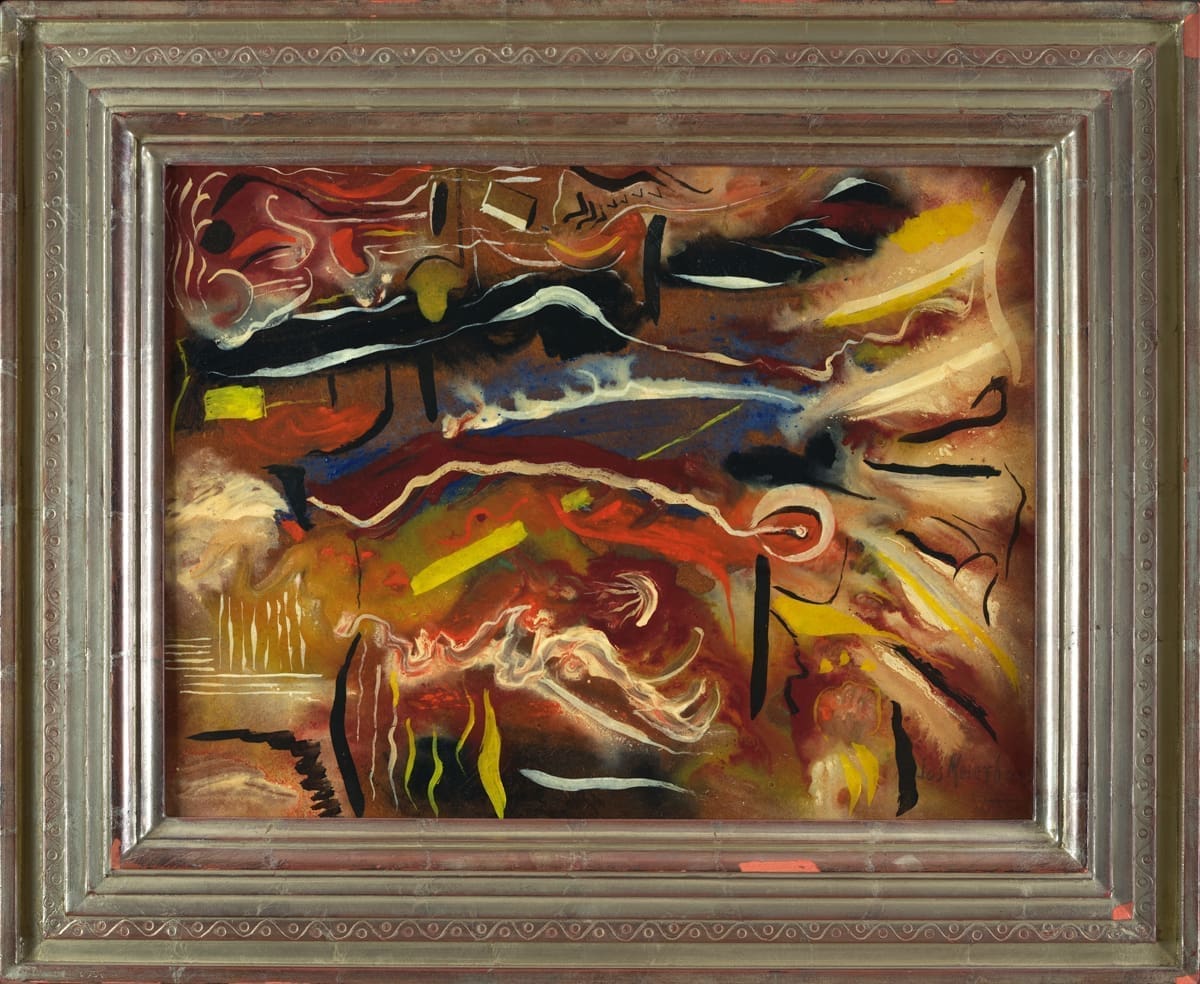
Meierhans’ “Modernistic Composition”
Title: “Modernistic Composition”
Type: Oil on Board
Year:
Size: 12″ x 17″
Signed: SLR
Description
Joseph Meierhans (1890–1981)
From Swiss Roots to American Modernism
Early Life & Immigration
Joseph Meierhans was born in 1890 in Switzerland, where he was initially trained as a textile designer. He brought with him a European sensibility and design discipline that would later influence his painting style. Meierhans emigrated to the United States in the early 20th century, settling in Pennsylvania, where he would become associated with the region’s burgeoning art scene.
Artistic Development
Although largely self-taught as a painter, Meierhans had a strong foundation in design and composition. His early works were representational, reflecting the influence of Pennsylvania Impressionism, but by the 1940s his art shifted decisively toward abstraction.
Meierhans became part of the post-war American modernist movement, experimenting with color fields, geometric forms, and lyrical abstraction. His work reflects a thoughtful synthesis of structure and spontaneity—where compositional rigor meets the intuitive freedom of modern expression.
Style & Philosophy
Meierhans often worked in oil, watercolor, and mixed media. His paintings balance vivid color with underlying form, creating dynamic visual rhythms that suggest landscapes, architecture, or pure emotion. While never fully aligned with Abstract Expressionism, Meierhans shared its emphasis on personal vision and direct engagement with the medium.
His modernist vocabulary drew from both European traditions and the energy of mid-century American innovation. He approached painting as an exploration of harmony, intuition, and mood, allowing viewers to discover their own interpretations.
Regional Impact
Living and working in eastern Pennsylvania, Meierhans was an important presence in the Bucks County and Lehigh Valley art communities. He exhibited at the Allentown Art Museum, the Pennsylvania Academy of the Fine Arts, and various regional venues. His work resonated with collectors who appreciated abstraction infused with a human, poetic touch.
In addition to painting, Meierhans contributed to local art education and encouraged the cross-pollination of ideas between traditional landscape painters and younger modernists.
Legacy
Joseph Meierhans passed away in 1981, leaving behind a body of work that bridges two continents and multiple artistic movements. His legacy continues through works held in museum and private collections, as well as in the influence he had on regional artists embracing abstraction.
Today, Meierhans is recognized as a quietly influential modernist—one who brought European refinement and American experimentation into a uniquely lyrical balance. His art endures as a testament to the power of adaptation, vision, and enduring curiosity.