Sub-Total: $0.00
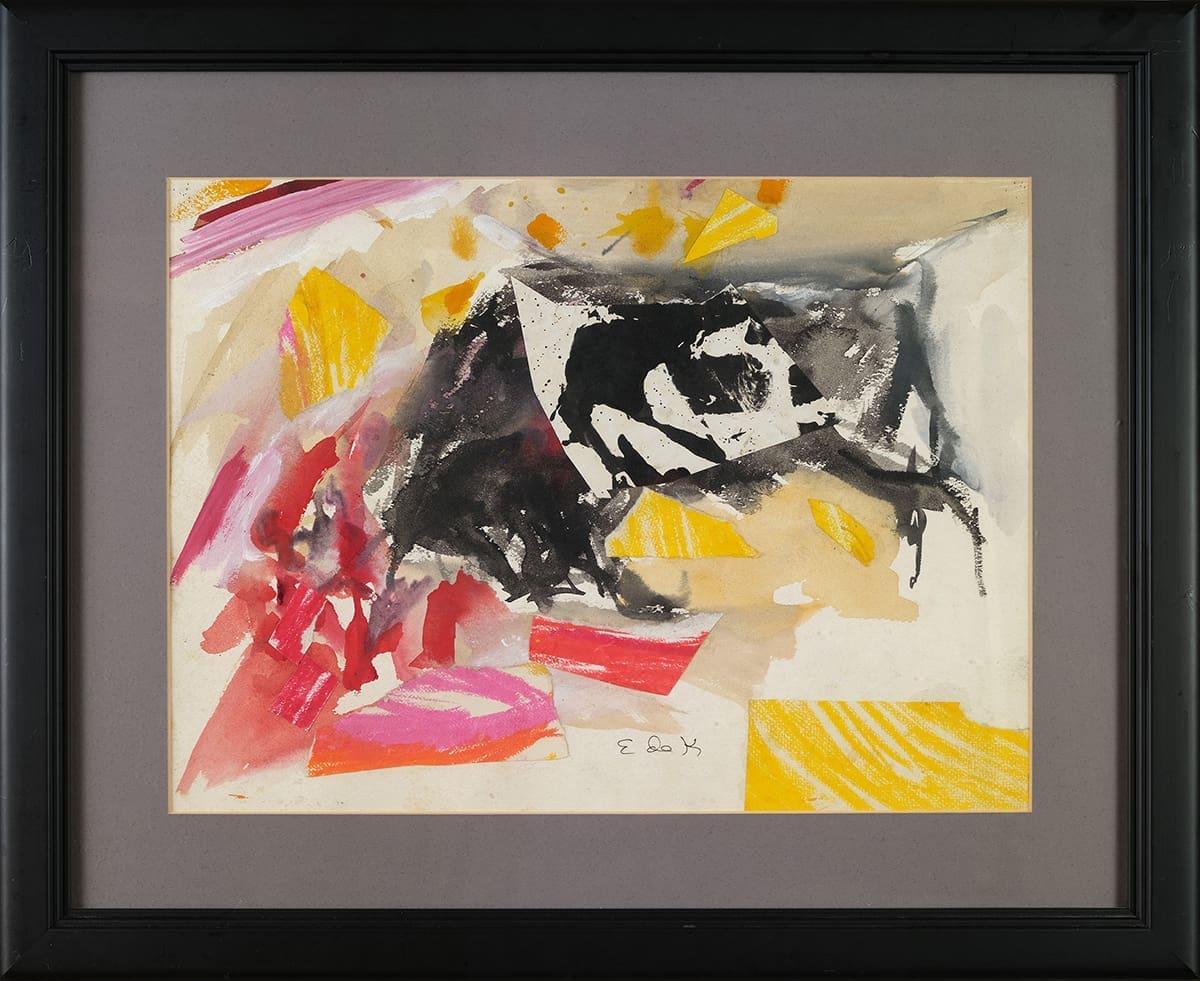
de Kooning’s “Bull”
Title “Bull”
Type Watercolor on paper
Year
Size 12” x 18″
David Rago Auction lot 678 Modern Art Auction 2006
Signed: Lower Center
Price Available on Request
Description
Elaine de Kooning (1918–1989)
Figurative Expressionist and Influential Art Writer
Early Life & Education
Elaine de Kooning was born Elaine Fried in Brooklyn, New York, in 1918. She showed early promise as an artist and attended the Leonardo da Vinci Art School, the American Artists School, and later the Hofmann School, where she studied under Hans Hofmann, a prominent abstract expressionist.
In 1943, she married fellow artist Willem de Kooning, becoming part of the first-generation Abstract Expressionist movement in New York. Elaine, however, forged a distinct identity as both a painter and a writer, balancing her creative practice with a highly respected career as an art critic and educator.
Artistic Style & Contribution
While often associated with the Abstract Expressionist school, Elaine de Kooning worked primarily in a figurative mode. Her work combined gestural brushstrokes and abstraction with recognizable subjects—most notably, portraits. Her dynamic painting style echoed the energy and immediacy of action painting, but she remained committed to the figure throughout her career.
Her most famous series includes expressive portraits of cultural figures like John F. Kennedy, whom she painted in 1962. Her Kennedy portraits are widely celebrated for their emotional resonance and painterly verve.
Elaine also explored themes of myth, dance, and the human form in motion, creating images that feel both spontaneous and deeply observed. She moved fluidly between realism and abstraction, producing a uniquely American take on Expressionist portraiture.
Writing, Teaching & Advocacy
Elaine de Kooning was a prominent voice in the postwar art world, writing for *Art News* and other major publications. She championed artists such as Franz Kline, Arshile Gorky, and her husband, Willem de Kooning, while also offering critical insights into the shifting landscape of modern art.
She taught at numerous institutions, including the University of New Mexico, Yale University, and the University of Georgia, and mentored a generation of younger artists.
Connection to New Jersey and Bucks County
Later in life, Elaine spent time painting and teaching in the Mid-Atlantic region, including parts of New Jersey and Pennsylvania. Her influence extended well beyond the New York School, and she engaged with artists and students across the East Coast. While not a central figure in the Bucks County scene, her impact and presence were nonetheless felt by regional artists interested in merging the expressive and the representational.
Legacy
Elaine de Kooning died in 1989, leaving behind a rich legacy as an artist, writer, and advocate for modernism. Her work is held in the collections of the Museum of Modern Art, the National Portrait Gallery, the Whitney Museum of American Art, and many others.
Today, she is recognized not only as an important contributor to Abstract Expressionism but also as a pioneering woman in a male-dominated movement—an artist who combined intellect, intuition, and a powerful sense of presence in both her paintings and her prose.