Sub-Total: $0.00
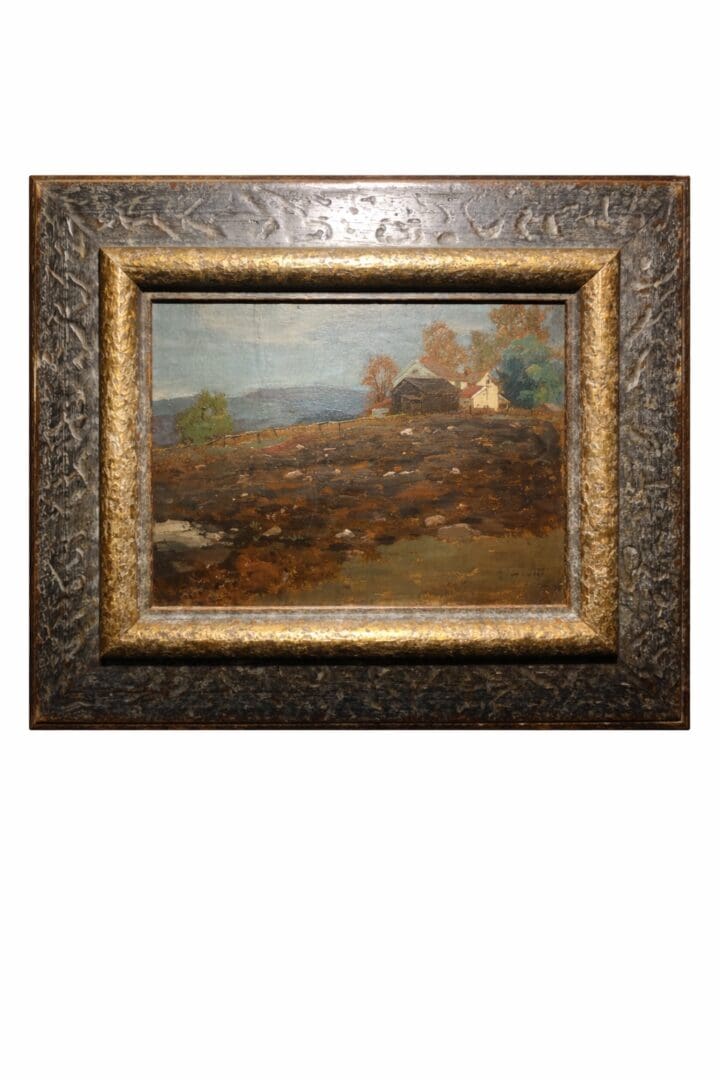
Cimiotti’s “A Gray Day”
Title: “A Gray Day”
Type: O/C
Year:
Size: 7 1/2″ x 10 1/8″
SLR
Price available upon Request
Description
 Gustav Cimiotti (1875–1969)
Cimiotti modern American Artist and Art Educator
Early Life & Background
Gustav Cimiotti was born in 1875 in Germany and emigrated to the United States with his family during his youth. He grew up in Newark, New Jersey, and quickly demonstrated an aptitude for art. He studied at the National Academy of Design in New York and later received additional instruction in Paris, where he was exposed to the currents of French Impressionism and the Barbizon school.
This international background helped shape Cimiotti’s artistic identity—a blend of European technique and American sensibility.
Artistic Style & Influences
Cimiotti worked primarily in oil and watercolor, developing a style that fit squarely within the American Impressionist tradition. His landscapes and coastal scenes are noted for their loose brushwork, bright yet naturalistic color palette, and poetic handling of light. Like his contemporaries in Bucks County and New England, he focused on nature’s quieter, more contemplative moments.
He often painted scenes from New Jersey, Long Island, and New England, capturing rural fields, rolling hills, meadows, and seascapes with an air of peaceful reverence. Cimiotti was especially drawn to the changing seasons and the nuances of atmospheric light.
While he was not as widely known as some of his Impressionist peers, his works exhibit a strong sense of design and a lyrical quality that appealed to both academic audiences and regional collectors.
Teaching & Influence
Gustav Cimiotti was a dedicated teacher throughout his life. He taught at the Newark School of Fine and Industrial Arts for many years and mentored a generation of students interested in traditional techniques and plein air painting.
He was also active in numerous art organizations, including the Salmagundi Club and the American Watercolor Society. His role as a teacher and arts advocate helped elevate the profile of the New Jersey art scene in the early 20th century.
Legacy
Cimiotti’s career spanned decades of change in American art—from the dominance of academic realism through the rise of modernism. He remained true to the Impressionist principles of beauty, atmosphere, and connection to nature. His works were exhibited at the National Academy of Design, the Art Institute of Chicago, and other regional institutions.
Gustav Cimiotti passed away in 1969. Though often overlooked in broader surveys of American art, he remains an important figure in the story of New Jersey’s artistic heritage. His serene, light-filled landscapes continue to be appreciated for their craftsmanship and quiet emotional resonance.