Sub-Total: $0.00
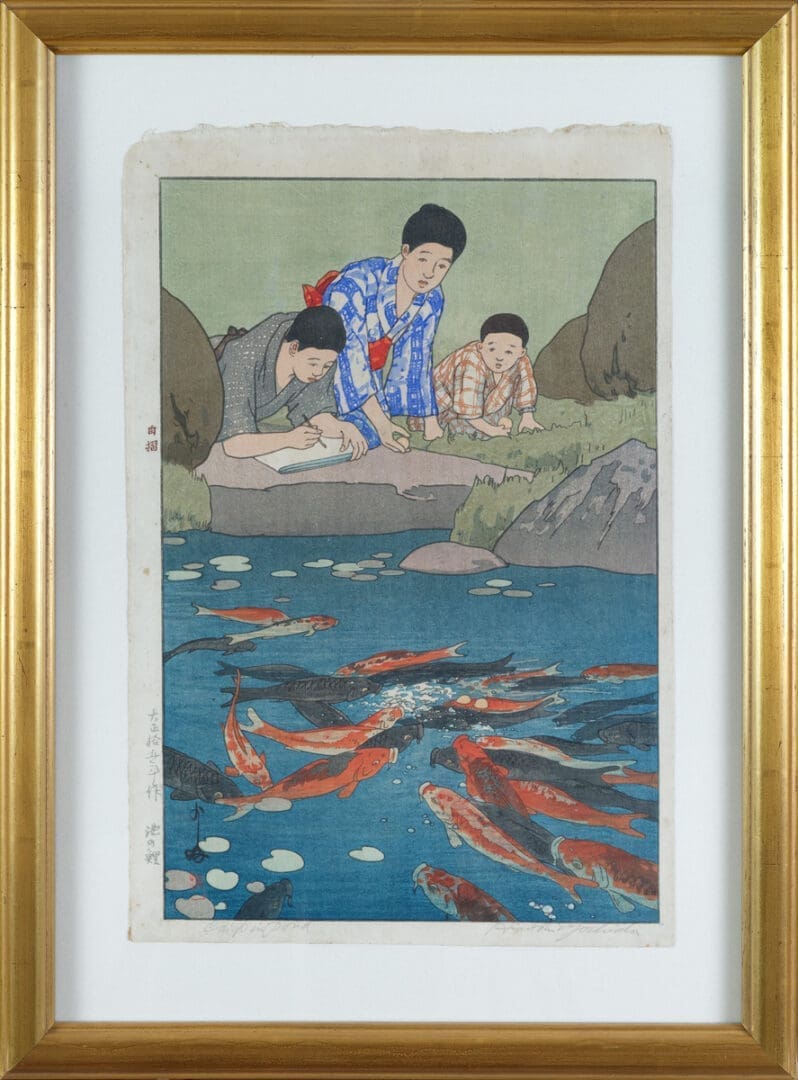
Yoshida’s “Carp In Pond”
Title “Koi Pond”
Type Woodblock Print
Year
Size 10 3/4″ x 16″
Price On Request
Signed SLR
Description
Hiroshi Yoshida (1876–1950)
Hiroshi Yoshida was a Master of Modern Japanese Woodblock Prints
Early Life & Western Training
Hiroshi Yoshida was born in Kurume, Japan, in 1876 and is celebrated as one of the most important woodblock printmakers of the 20th century. Initially trained in Western-style painting (yōga), Yoshida studied at the prestigious Fudōsha and later at private academies where he learned oil painting, watercolors, and drawing, gaining recognition early in his career for his landscape work.
He traveled extensively across Europe and the United States beginning in the early 1900s, exhibiting his paintings abroad and absorbing Western artistic influences that would later inform his printmaking technique and subject matter.
Revival of the Shin-Hanga Movement
Although Japan’s ukiyo-e tradition had declined by the late 19th century, the early 20th century saw a revival through the shin-hanga (“new prints”) movement, which sought to modernize woodblock printing while preserving its craftsmanship. Yoshida became one of the movement’s leaders, but unlike other artists who relied on publishers, he famously established his own print studio.
Yoshida supervised every stage of production in his studio—from carving and printing to paper selection—ensuring a high degree of control and artistry. His hybrid style combined Japanese woodblock methods with Western realism and perspective.
Themes and Technique
Yoshida is best known for his woodblock prints depicting Japanese temples, mountains, and coastal scenes as well as his vivid travel prints from India, Europe, Egypt, and Southeast Asia. His famous series such as “Twelve Scenes of Japan,” “Views of Mount Fuji,” and his various travel portfolios show his mastery of light, weather, and architectural detail.
He frequently used multiple color blocks to depict the same scene at different times of day or under changing weather, demonstrating subtle shifts in mood and atmosphere. His command of color gradation and layering made his prints remarkably rich and evocative.
Legacy and Influence
Hiroshi Yoshida’s international vision and meticulous craftsmanship placed him at the crossroads of Japanese tradition and global modernity. He helped revive interest in Japanese woodblock printing at a time when it risked fading into obscurity.
His works are held in major institutions such as the Museum of Fine Arts in Boston, the National Museum of Modern Art in Tokyo, and the British Museum. Today, Yoshida is regarded as one of the most skilled and innovative printmakers of the shin-hanga movement.
He passed down his legacy to the Yoshida family, including his wife Fujio and son Tōshi Yoshida, both of whom continued the family’s printmaking tradition.
Legacy
Hiroshi Yoshida’s prints represent a harmonious blend of East and West, tradition and innovation. Through his disciplined technique and global perspective, he brought new life to the centuries-old craft of Japanese woodblock printing and inspired generations of artists and collectors around the world.
NewJerseyPennsylvaniaArt.COM