Sub-Total: $0.00
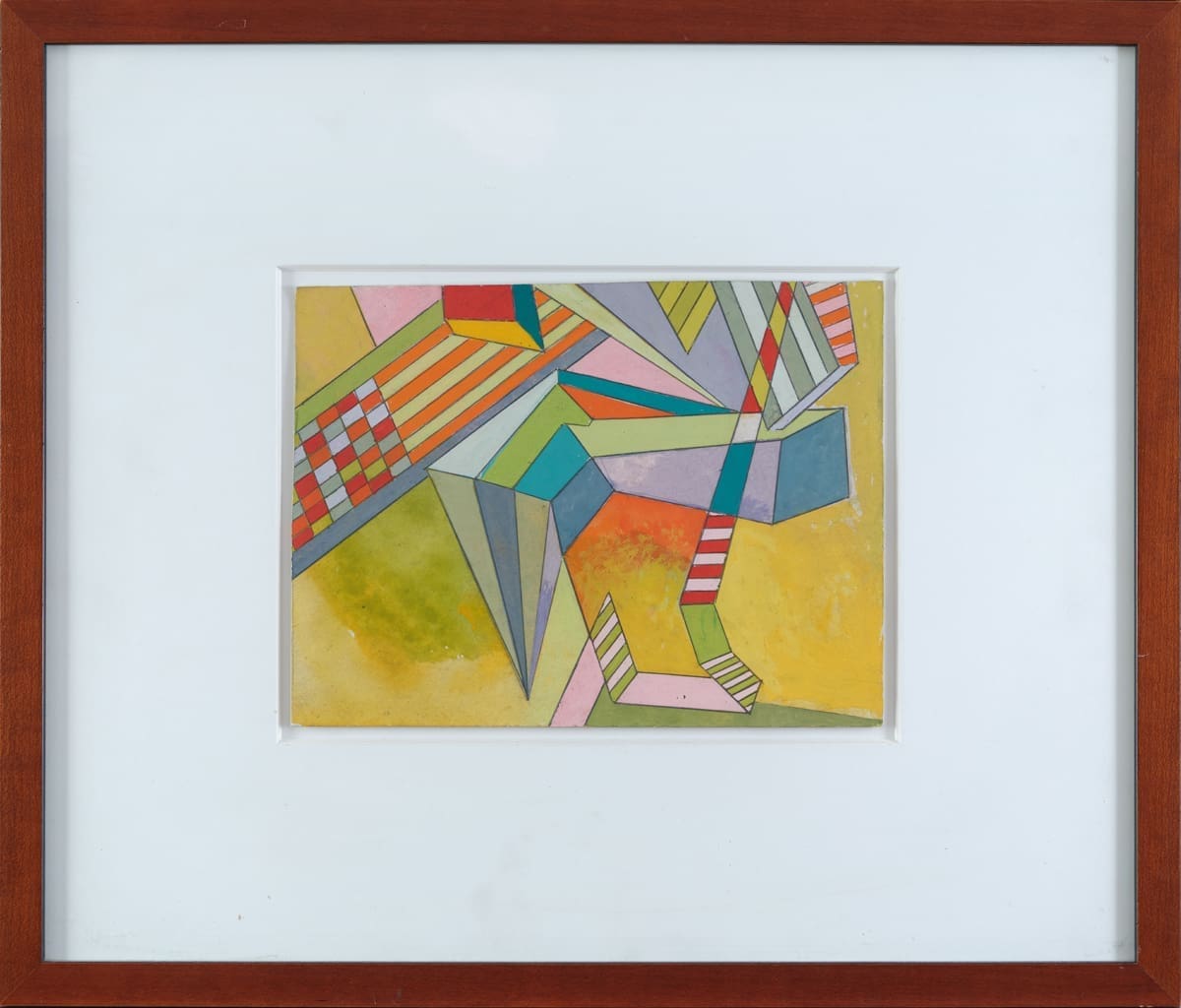
Scarlett’s “Guache On Paper”
Title Abstract
Type Guache On Paper
Year
Size 7 1/2″ x 10″
Price On Request
Description
Rolph Scarlett (1889–1984)
Rolph Scarlett worked in structural geometric abstraction. Visionary of American Modernism
Early Life & Education
Rolph Scarlett was born in Guelph, Ontario, Canada, in 1889 and immigrated to the United States in the early 20th century. A self-taught artist in his early years, Scarlett initially worked in theater set design and industrial design before devoting himself fully to fine art. In the 1920s, he traveled to Europe, where he was exposed to Constructivism, the Bauhaus, and early modernist thought. These experiences had a lasting impact on his approach to painting, structure, and form.
By the 1930s, Scarlett had settled in the United States and was establishing himself as a bold voice in the development of American abstraction.
Artistic Style & Modernist Evolution
Scarlett’s work is defined by his pioneering use of geometric abstraction. He was deeply influenced by Kandinsky, Klee, and Mondrian, and his paintings often feature dynamic arrangements of shapes, lines, and vibrant color fields. Scarlett believed that art should convey universal emotion through pure form and rhythm rather than representational subject matter.
His compositions often resemble mechanical blueprints or cosmic diagrams—expressive yet rigorously composed, balancing spontaneity with mathematical harmony. Scarlett worked across media including painting, monotype, sculpture, and industrial design, always driven by a vision of abstraction as a language of transcendence.
Association with Hilla Rebay & the Guggenheim
Rolph Scarlett’s career took a pivotal turn when he was discovered by Hilla Rebay, the influential curator and advisor to Solomon R. Guggenheim. Rebay included Scarlett among a select group of artists promoted by the Museum of Non-Objective Painting, the forerunner to the Guggenheim Museum in New York.
Between the 1930s and 1950s, Scarlett exhibited extensively with the Guggenheim, where he was considered one of the central figures in American non-objective art. At one point, the museum held over 60 of his works in its collection, cementing his role in the early institutional support for abstraction in the U.S.
Later Years & Legacy
Despite his early prominence, Scarlett’s name faded somewhat during the rise of Abstract Expressionism, which emphasized gestural rather than geometric abstraction. Nonetheless, he continued to paint prolifically into his 80s, producing vivid, experimental compositions that remained true to his ideals.
In his later years, his work enjoyed a resurgence of interest, especially as museums and scholars began to reexamine the contributions of early American abstractionists. Today, Scarlett’s works are held in the collections of the Guggenheim Museum, the Smithsonian American Art Museum, the Whitney Museum of American Art, and the Museum of Modern Art.
Rolph Scarlett passed away in 1984 at the age of 95, leaving behind a powerful legacy of innovation and purity in visual language. His commitment to non-objective art helped shape the foundations of modernism in North America and continues to inspire abstract artists around the world.
NewJerseyPennsylvaniaArt.COM