Sub-Total: $0.00
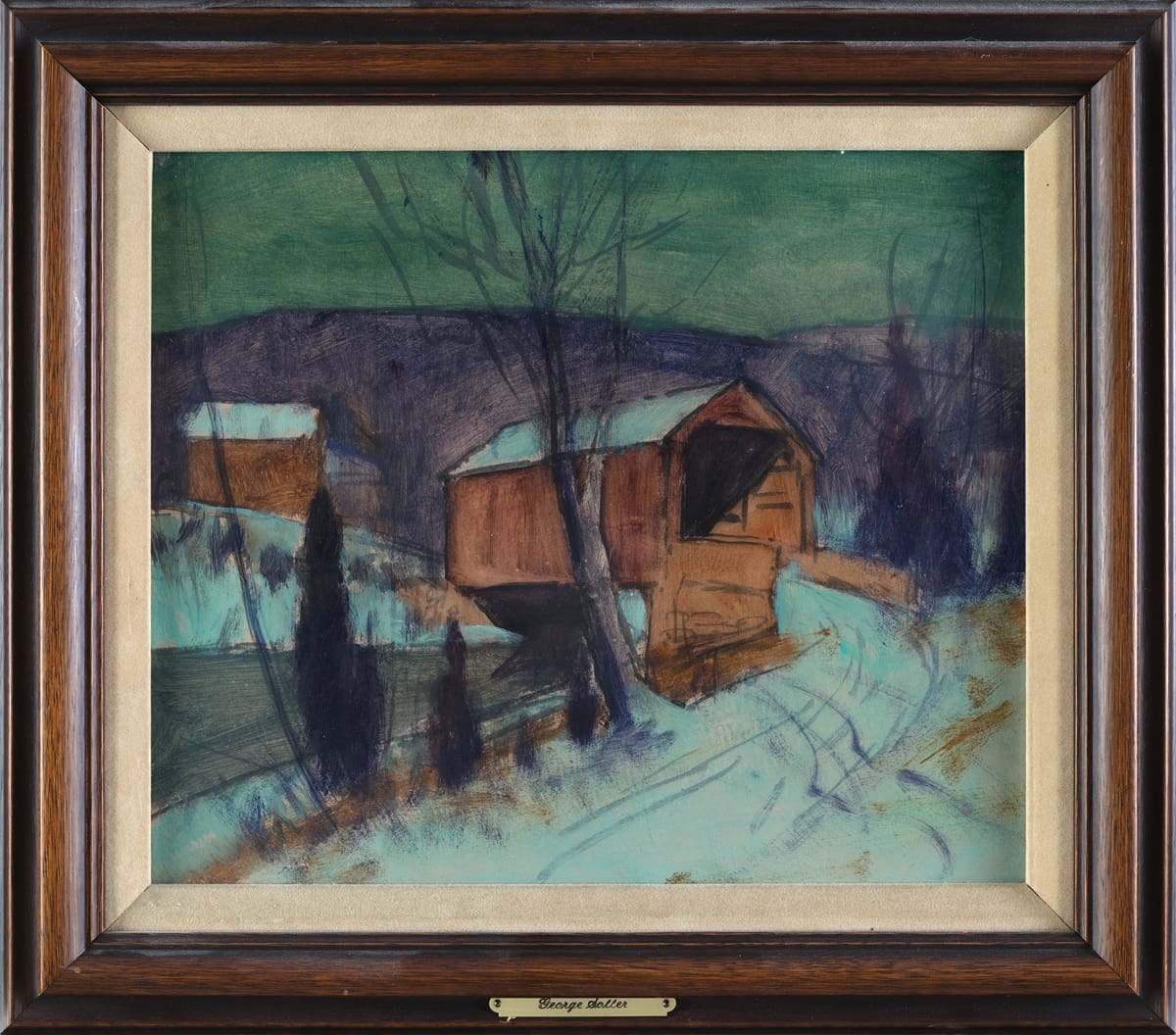
Sotter’s “Covered Bridge”
Title “Covered Bridge”
Type O/B Sketch
Year
Size 10″ x 11 1/2″
Name Plate On Bottom Of Frame
September 16, 2005 Alderfer’s Auction Lot 525
Description
George W. Sotter (1879–1953)
George Sotter combined craftsmanship with fine art traditions. Painter of Nocturnes and Pennsylvania Impressionist
Early Life & Education
George William Sotter was born in Pittsburgh, Pennsylvania, in 1879. He initially trained in stained glass art before turning his attention to painting. He studied at the Pennsylvania Academy of the Fine Arts under the guidance of Thomas Anshutz and William Merritt Chase, two leading American painters of the day.
Sotter also studied in Europe, where he was exposed to both academic training and the emerging Impressionist movement. This blend of influences shaped his personal style, which would become known for its luminous color and tranquil moods.
Artistic Style & Focus
Sotter is best remembered for his atmospheric landscape paintings, particularly his celebrated nocturnes—night scenes suffused with moonlight and subtle illumination. These paintings often depict quiet villages, snowy hillsides, church spires, and barns under shimmering starlight or moon-glow. His mastery of light and tone earned him a reputation as a leading poetic interpreter of nighttime rural life.
Although he worked in a traditional Impressionist vein, Sotter’s palette and mood set him apart from many of his contemporaries. He favored cool blues, silvers, and soft whites to evoke stillness and introspection, creating dreamlike scenes that blend realism with an almost spiritual calm.
Bucks County & New Hope School
In 1902, Sotter settled in Holicong, near New Hope in Bucks County, Pennsylvania. He quickly became associated with the Pennsylvania Impressionists, also known as the New Hope School, and was a close friend and colleague of Edward Redfield, Daniel Garber, and Walter Schofield.
Sotter’s home and studio—an old stone farmhouse—became a hub for artistic activity. There, he painted prolifically and also operated a successful stained glass studio with his wife, Alice Bennet Sotter, herself a talented artist.
Exhibitions & Recognition
Sotter exhibited widely during his career, including at the National Academy of Design, the Pennsylvania Academy of the Fine Arts, and the Corcoran Gallery in Washington, D.C. His works were well-received, and he garnered numerous awards for both his painting and stained glass designs.
Legacy
George Sotter passed away in 1953, leaving behind a remarkable body of work that continues to captivate collectors and historians. His paintings are held in the collections of the James A. Michener Art Museum, the Philadelphia Museum of Art, and numerous private holdings.
Today, Sotter is revered as a key figure in the Pennsylvania Impressionist movement. His luminous nocturnes remain unparalleled in their mood and beauty, securing his place as one of the great poetic landscape painters of 20th-century American art.