Sub-Total: $0.00
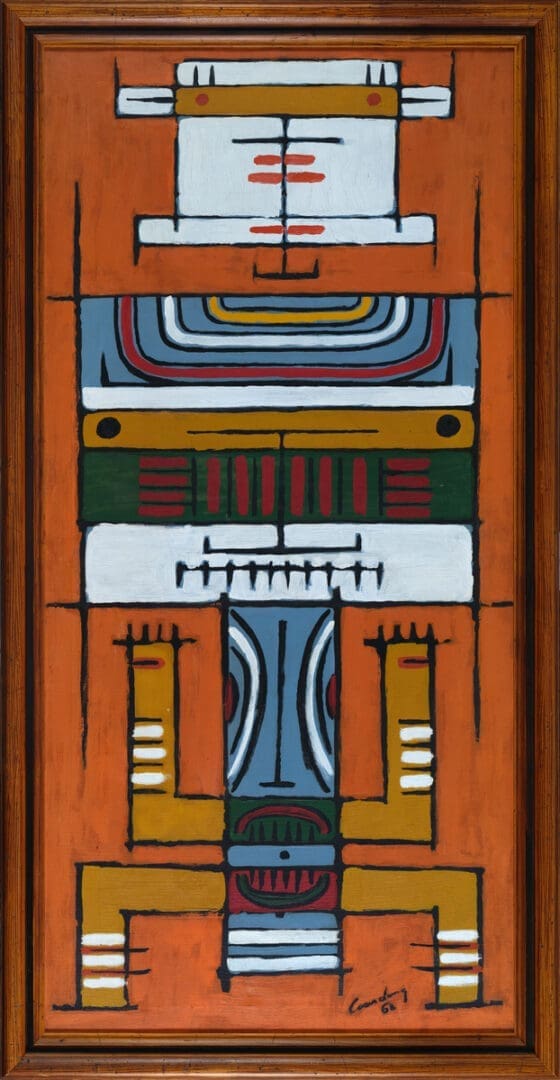
Coarding’s “Abstract”
Title: “Abstract”
Type: O/C
Year: 1962
Size: 24″ x 50″
Signed: SLR
Description
Gerald Coarding was an American abstract artist whose work emphasized shape, structure, and modern visual language.
Gerald Coarding (June 5, 1911 – March 1986) was an American modernist painter whose work bridged European avant‑garde influences with a distinct mid‑century abstract vision. Born in Fort Wayne, Indiana, Coarding’s journey as an artist took him from the midwestern United States to the studios of New York and Paris, and eventually to New Jersey, where he spent his later years.
Coarding studied with some of the most influential figures of his time. He attended the School of the Art Institute of Chicago and later studied under Hans Hofmann in New York and Fernand Léger in Paris. He also spent time at the Academy of Fine Arts in Naples. During World War II, Coarding served in the European theatre; after the war he spent a period in Paris where he produced several significant works.
In the postwar period, Coarding entered New York’s art world while also working in non‑art roles—including a position at Chase Manhattan Bank in New York City. It was there that a painting of his was selected for the Bank’s collection (reportedly at the instigation of David Rockefeller) by a distinguished committee of curators.
He first exhibited in major venues in the late 1940s, including the Art Institute of Chicago in 1947, and later at the Whitney Museum of American Art in 1955. Coarding’s subject matter evolved into bold abstractions, often exploring geometric forms, figurative hints, and a vivid palette suggestive of his transatlantic influences.
By the 1960s and ’70s, while maintaining ties to New York, Coarding established roots in New Jersey (he died in Dorothy, NJ in 1986). In 1985, shortly before his death, his work was exhibited at the Noyes Museum of Art in Oceanville, NJ, as part of a rediscovery of New Jersey‑based modernists. Over time, Coarding’s paintings have appeared in auction records, with works from the 1950s and 60s commanding significant interest. His legacy lies in the interplay of American post‑war abstraction and European modernist training—yielding an oeuvre that is stylishly of its era yet distinct in voice.
Today, collectors and institutions recognize Coarding as a noteworthy figure of mid‑century American abstraction, particularly valued for his link to New Jersey’s art history and the broader Atlantic modernist network.