Sub-Total: $0.00
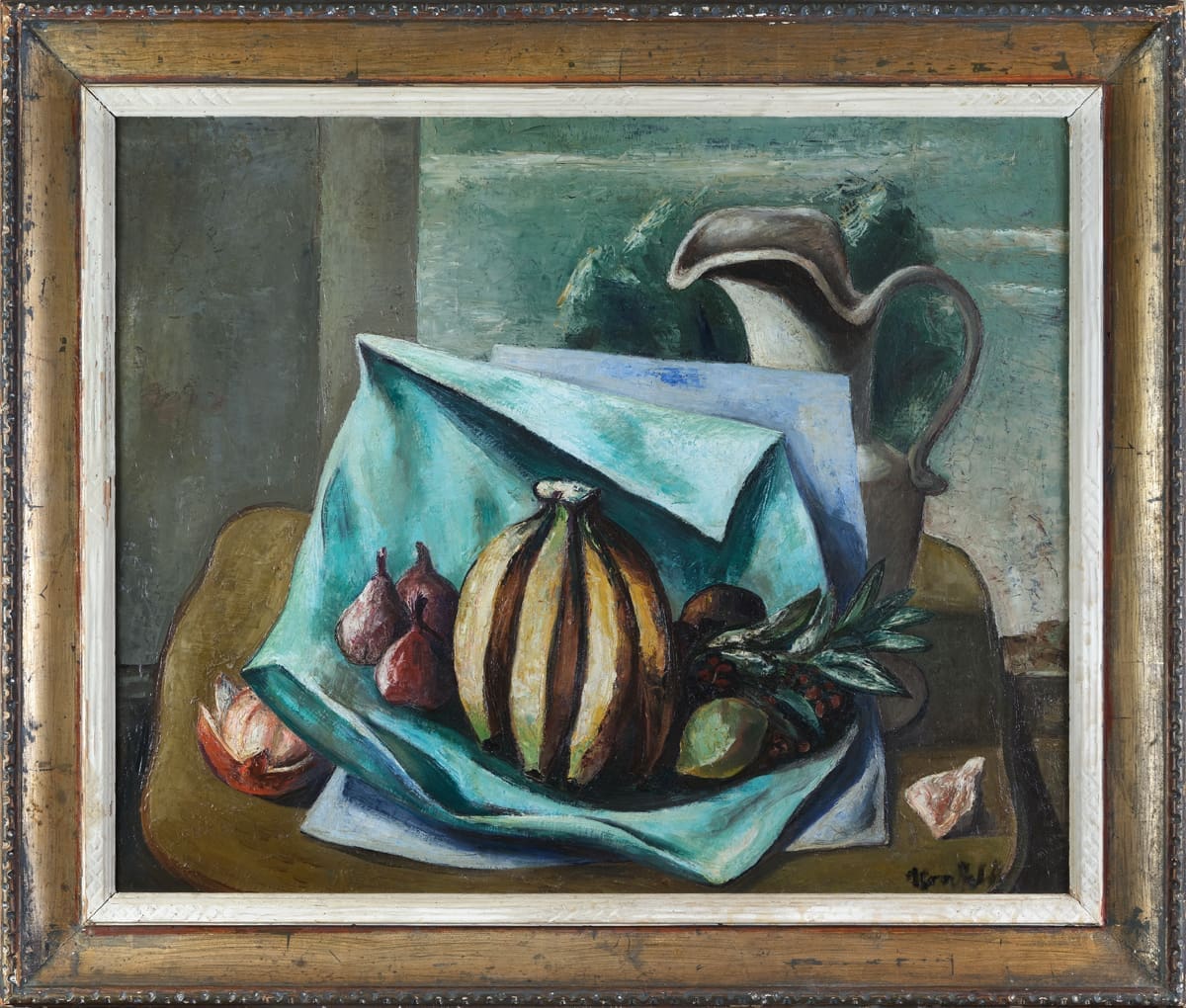
Nordfeldt’s “Still Life”
Title “Still Life”
Type O/C
Year
Size 32 1/2″ x 26 1/2″
Signed SLR
Provenance Letter, Purchased from Lambertville Gallery of Fine Art
Price on Request
Description
B.J.O. Nordfeldt (1878–1955)
B.J.O. Nordfeldt, artist, Modernist, Innovator of American Art
Early Life & European Training
Bror Julius Olsson Nordfeldt was born in Tullstorp, Sweden, in 1878 and immigrated to the United States with his family in 1891. He settled in Chicago, where he studied at the Art Institute of Chicago. He later traveled to Paris to study at the Académie Julian and was influenced by the work of Paul Cézanne and other Post-Impressionists.
During his time in Europe, Nordfeldt absorbed a wide range of influences, including Symbolism, Fauvism, and Japanese woodblock prints. These varied inspirations informed his evolving aesthetic and would later distinguish him as one of the most original modernist painters in early 20th-century American art.
American Career & Artistic Style
Returning to the U.S., Nordfeldt worked for a time as a printmaker, creating woodcuts and etchings. He became involved with the Provincetown art colony and was associated with the group known as the Provincetown Printers, who helped develop the white-line woodcut technique—a uniquely American innovation in printmaking.
Nordfeldt’s painting style evolved rapidly. His works featured flattened forms, expressive color, and rhythmic composition. He painted portraits, landscapes, still lifes, and scenes of American life with a distinct modernist sensibility. His subjects ranged from Native American and immigrant communities to scenes from his travels in the American Southwest, New York, and eventually Pennsylvania and New Jersey.
Regional Influence & Teaching
In the later part of his career, Nordfeldt lived and worked in New Jersey and Pennsylvania. He was a teacher at various institutions, including the Minneapolis School of Art and Utah State University, and had a lasting influence on generations of American artists.
Though he moved between artistic circles, Nordfeldt maintained a strong independent streak. He resisted categorization, instead fusing decorative elements with psychological depth. His portraits, in particular, were known for their stylization and introspective power.
Exhibitions & Recognition
Nordfeldt exhibited at the Armory Show in 1913, a landmark event in American modernism, and continued to show work at leading institutions throughout his life. His paintings are held in the collections of the Whitney Museum of American Art, the Smithsonian American Art Museum, the Art Institute of Chicago, and the James A. Michener Art Museum.
Legacy
B.J.O. Nordfeldt passed away in 1955, leaving behind a vast and varied body of work that defied easy classification. His innovations in printmaking, his bold approach to form and color, and his deep engagement with both American and European artistic traditions make him a pivotal figure in the story of modern American art.
Today, he is remembered as an artist who embraced both experimentation and humanity—a modernist with roots in the Old World and eyes on the future.