Sub-Total: $0.00
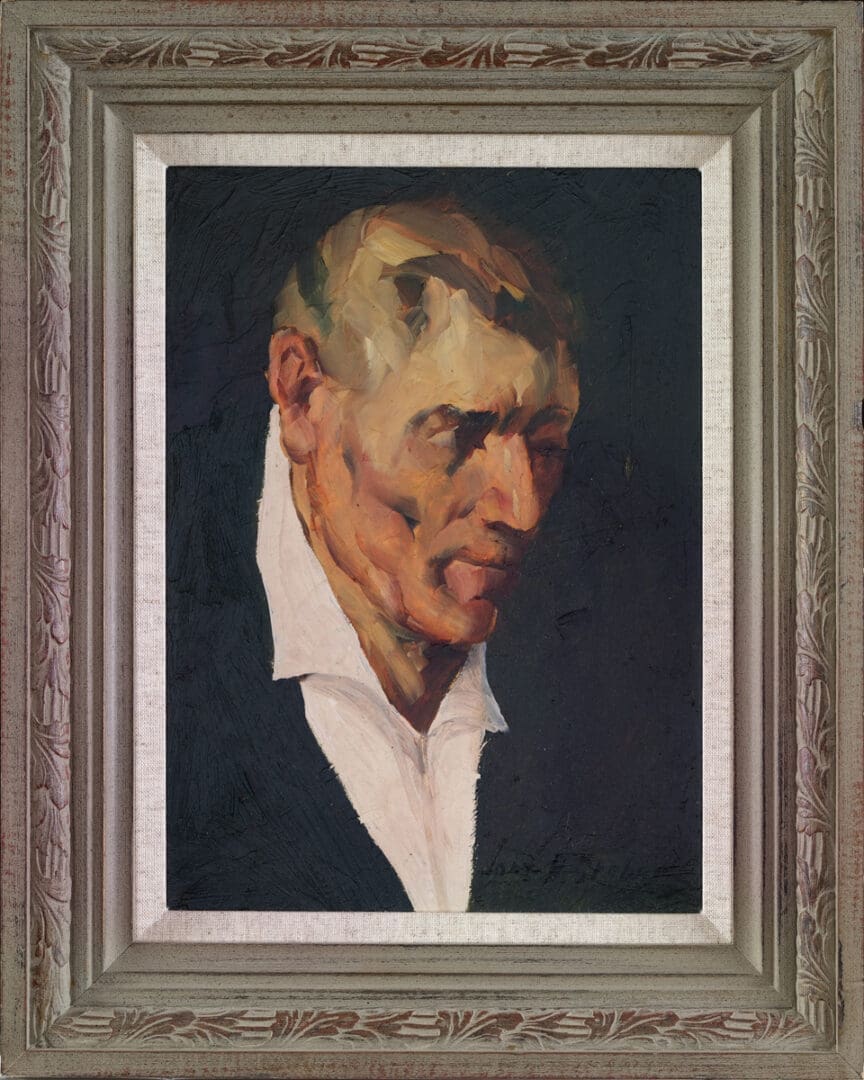
Grabach’s “Head Of A Man”
Title “Head Of A Man”
Type O/C
Year
Size 9 3/4″ x 13″
Price on Request
Description
John R. Grabach (1886–1981)
American Scene Painter of New Jersey Life
Early Life & Education
John R. Grabach was born in 1886 in Newark, New Jersey, where he would spend much of his life and become one of the state’s most prominent painters of the 20th century. He studied at the Art Students League of New York and was deeply influenced by the Ashcan School and the American Realist tradition. Early in his career, Grabach admired the work of Robert Henri, George Bellows, and John Sloan, whose gritty portrayals of urban life helped shape his own subject matter and style.
Painting Newark’s working-class neighborhoods and city streets, Grabach became a documentarian of New Jersey’s evolving identity through the Great Depression and beyond.
Artistic Style & Themes
Grabach’s art is often associated with American Scene painting, a movement that aimed to depict the everyday life of the American people with honesty and empathy. His work focused on the blue-collar neighborhoods of Newark, portraying factory workers, back alleys, crowded streets, and apartment interiors. His muted palette, expressive brushwork, and keen sense of atmosphere captured the struggles and resilience of urban life during periods of economic and social upheaval.
While rooted in realism, his paintings often carried a poetic and somber tone—imbued with both pride and pathos. He was particularly drawn to the solitary figure, presenting moments of quiet reflection amidst the industrial backdrop of his home city.
Teaching & Legacy
Grabach was a dedicated teacher and spent many years on the faculty of the Newark School of Fine and Industrial Arts, where he mentored a new generation of artists. He remained active well into the 20th century, even as styles shifted toward abstraction and modernism.
In the 1970s and 1980s, Grabach’s work experienced renewed appreciation, particularly among collectors and historians interested in American realism and regionalist art. He was the subject of retrospectives and scholarly attention that recognized his role in preserving the human face of industrial America.
Legacy
John R. Grabach passed away in 1981, having spent nearly a century witnessing and interpreting the changes of American life. His paintings are held in collections such as the Smithsonian American Art Museum, the Newark Museum of Art, and the Butler Institute of American Art.
Grabach’s legacy lies in his unflinching yet compassionate portrayals of working-class New Jersey and his enduring contribution to the visual history of American urban life.