Sub-Total: $0.00
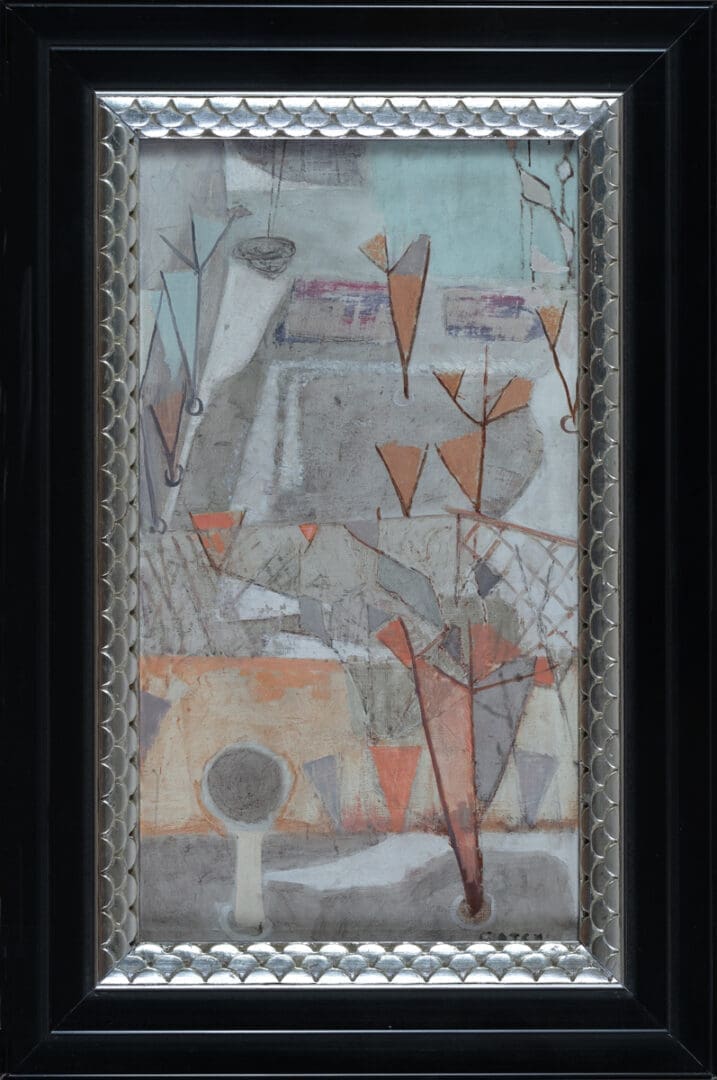
Gatch’s “Backyard”
Title “Backyard”
Type: O/C
Year:
Size: 10″ x 18″
Price available upon Request
Description
Lee Gatch (1902-1968)
Modernist Painter, Symbolist, and American Colorist
Lee Gatch blended abstraction with landscape traditions. He was a significant yet often underrecognized figure in 20th-century American art, known for his deeply personal brand of modernist painting that fused symbolism, abstraction, and color theory. Working in an era dominated by both American Regionalism and European modernism, Gatch carved a distinct path that defied artistic trends and prioritized spiritual and poetic resonance over stylistic conformity. Born in Baltimore, Maryland in 1902, Lee Gatch studied at the Maryland Institute of Fine Arts before furthering his artistic education in New York under John Sloan at the Art Students League. In 1924, he traveled to Paris to study at the Académie de la Grande Chaumière, where he encountered the works of Pierre Bonnard, Édouard Vuillard, and the Nabis painters-artists whose influence would deeply inform his lifelong aesthetic commitment to symbolic color and decorative form. While living abroad, Gatch absorbed the visual vocabulary of post-impressionism, cubism, and the spiritual abstraction of artists like Odilon Redon and Paul Klee. However, rather than imitating European styles, Gatch integrated these influences into a uniquely American vision rooted in myth, memory, and nature. His compositions often combined figural suggestions with richly colored landscapes and dreamlike imagery, bridging the visible world with inner emotional states. By the early 1930s, Gatch had returned to the United States and began to exhibit in New York City. Despite being loosely affiliated with the American modernist movement, he often stood apart from his peers due to the poetic and romantic qualities of his work. He participated in several exhibitions at the Whitney Museum of American Art and the Museum of Modern Art, and was included in the influential 1939 New York World’s Fair “American Art Today” show.
In 1933, Gatch married fellow artist Elsie Driggs, a Precisionist painter associated with the Stieglitz circle. The couple settled in Lambertville, New Jersey, where Gatch would work in relative seclusion for the rest of his life. In this rural setting, he continued to paint prolifically, favoring small canvases with luminous colors, enigmatic figures, and layered symbolic meaning. Gatch’s paintings resist easy classification. They are often called mystical or visionary, evoking the structure of medieval stained glass or ancient tapestries. He employed layered glazes and textured surfaces to build up light-filled compositions that radiate a spiritual intensity. Art historian Peter Bermingham described Gatch’s style as “symbolist and synthetic,” noting its unique ability to merge decorative modernism with an emotional and metaphysical depth. Though he remained outside the commercial mainstream, Gatch earned institutional recognition during his lifetime. His work was collected by the Whitney Museum, the Phillips Collection, the Brooklyn Museum, and other important institutions. Critics admired his technical rigor and artistic independence, even as his name was overshadowed by flashier movements like Abstract Expressionism in the postwar years. Lee Gatch died in 1968, leaving behind a legacy of artistic integrity and visionary power. His work continues to be revisited by curators and collectors who value the quiet richness of his symbolist modernism. Gatch’s paintings stand as meditations on light, nature, and the spiritual dimensions of perception-reminders that even in the most abstract forms, beauty and mystery persist.