Sub-Total: $0.00
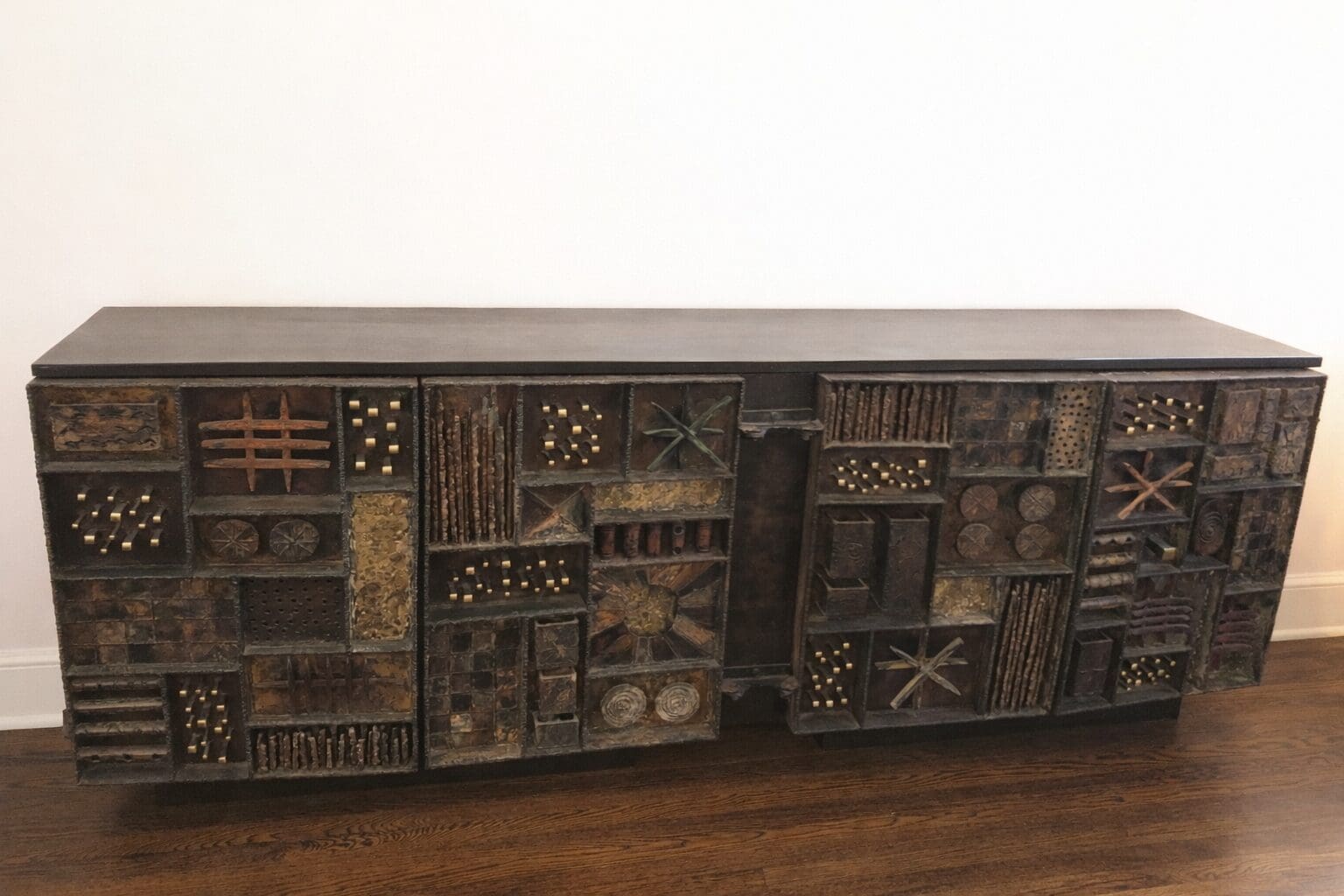
Evans’ “Buffet”
Magnificent Buffet With Slate Top 96″ Long
17 1/2″ Deep
32 1/2″ Height
Description
Paul R. Evans II (1931-1987)
Paul Evans was a highly regarded and influential American studio furniture artist bridging fine art and functional for. Sculptor-Designer.
Overview
Paul Evans was an influential American sculptor and furniture designer celebrated for redefining furniture as functional sculpture and revolutionizing the American Studio Craft movement. Known for his bold use of welded metal, textured surfaces, and avant-garde compositions, Evans made his artistic home in Bucks County and New Jersey, merging craftsmanship with industrial materials to create objects of enduring power and presence.
Early Life & Training
Born on May 20, 1931, in Newtown (Bucks County), Pennsylvania, Evans trained at the Philadelphia Textile Institute in 1950, Rochester Institute of Technology’s School for American Craftsmen, and the prestigious Cranbrook Academy of Art in Michigan in 1952. These formative experiences shaped his unique approach to metal and design.
Lambertville & Bucks County Studio
In 1955, Evans relocated his studio to a converted chicken coop on Goat Hill Road, Lambertville, New Jersey-just across the river from New Hope-where he established a creative partnership with woodworker Phillip Lloyd Powell. They shared gallery space in New Hope and collaborated closely for ten years. In 1960, he purchased a workshop in New Hope before expanding to Plumsteadville, Pennsylvania, employing a team of 35-80 craftsmen to realize his ambitious designs.
Signature Style & Iconic Series
Evans’s furniture is sculptural and bold, composed of metals like sculpted steel, copper, pewter, and bronze, often patinated or polished. He developed major design series:
- Sculpted Steel & Bronze: High-relief metal-front cabinets and case pieces featuring grid motifs and abstract mark-making.
- Argente (late 1960s): Experimental aluminum and pigment-infused surfaces, rare due to toxicity of process.
- Cityscape Series (1970s): Polished brass- and chrome-faced panels evoking urban architecture, launched through Directional Furniture in 1964.
Evans treated functional pieces as abstract art-his welding marks, engraved symbols, and collage-like surfaces render each piece as both historic object and modern sculpture.
Exhibitions & Legacy
Evans exhibited widely, including a two-man show in 1961 at America House (Museum of Contemporary Crafts, NY). In 2014, the Michener Art Museum in Doylestown, PA showcased “Paul
Evans: Crossing Boundaries and Crafting Modernism,” an expansive traveling retrospective highlighting his career-long innovation.
His work is now highly collectible and remains influential: museum retrospectives, auction sales reaching six-figure sums, and collectors such as Lenny Kravitz and Gwen Stefani include his pieces in their design-focused collections.
Final Years
At age 55, after retiring to Nantucket, Evans died on March 7, 1987, of a heart attack while watching the sunrise-a poetic end suited to a career defined by passion and creativity.
NewJerseyPennsylvaniaArt.COM
Reviews
There are no reviews yet.